
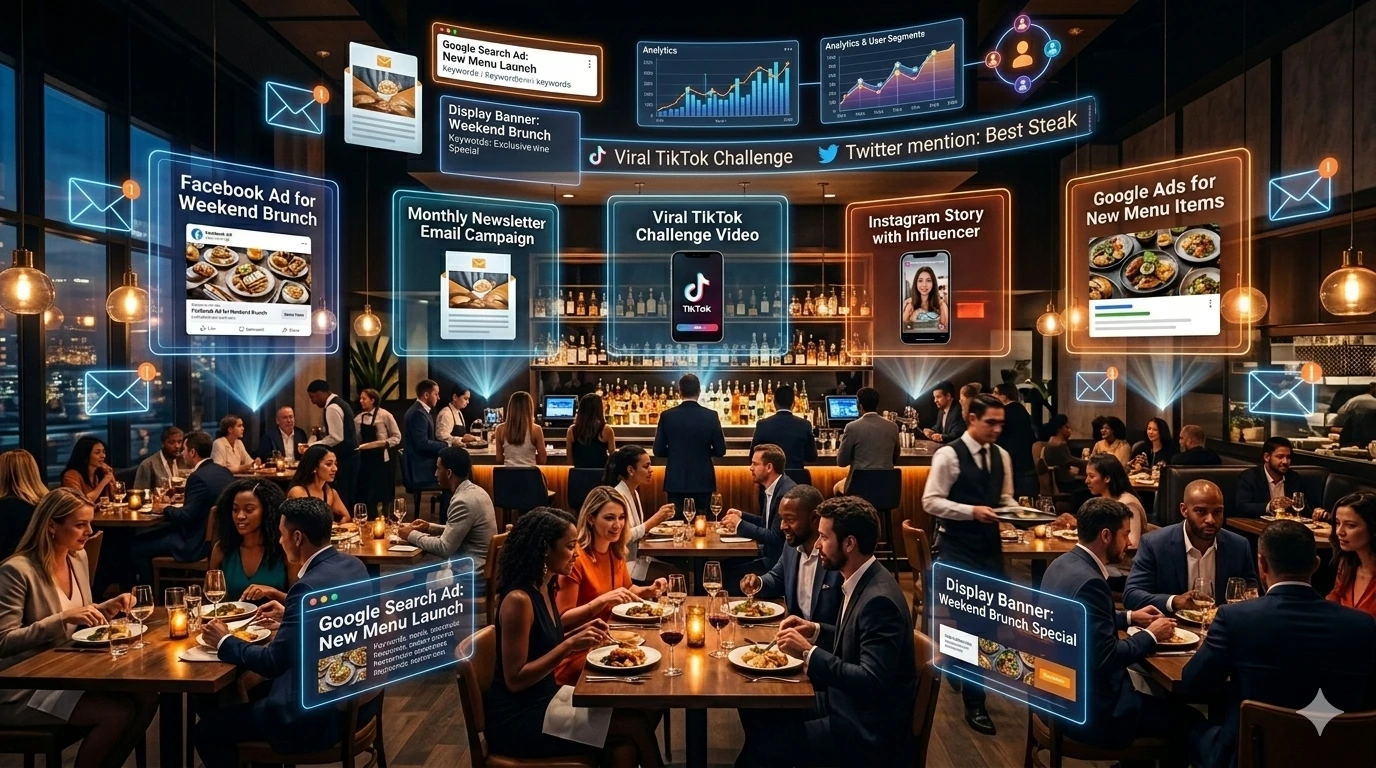
Most restaurant marketing advice tells you what to do. The campaigns below show you what actually works – backed by real results, real budgets, and the kind of creative thinking that turns a restaurant into a household name.
Some of these are from global chains with eight-figure budgets. Others cost almost nothing. All of them contain a lesson that independent restaurant owners can apply this week.
What separates a great restaurant marketing campaign from a forgettable one
Before the examples: the pattern. Every campaign on this list did at least one of these three things exceptionally well:
- It gave people something to talk about. Not just a discount or a new menu item – a story, a stunt, or a statement that spread because people wanted to share it.
- It was honest about something. The campaigns that cut through the noise usually said something true that competitors were too cautious to admit.
- It made the guest the hero. The best restaurant marketing is not about the restaurant – it is about the guest’s identity, values, or desire to belong to something.
Keep those filters in mind as you read through the examples below.
1. Domino’s Pizza Turnaround (2009-2010)
The campaign: Domino’s released genuine customer feedback calling their pizza “cardboard” and “tasteless” – in their own TV commercials. They then showed the internal process of rebuilding the recipe from scratch and invited the public to try the new version.
Why it worked: Radical honesty in an industry built on puffery. Every other pizza brand was claiming to be the best. Domino’s admitted they were the worst – and that they were fixing it. The vulnerability created enormous trust. Same-store sales grew 14.3% in the first quarter after launch, the strongest performance in the company’s history at that point. Domino’s stock went from roughly $7 in 2009 to over $400 a decade later.
What to steal: If your restaurant has genuinely improved something – the kitchen, the service, a dish that wasn’t working – say so publicly. Customers respond to honesty far more than they respond to boasts. A simple “we listened and changed X” post on social media, backed by a real story, outperforms any promotional offer.
2. Chipotle “Back to the Start” (2011)
The campaign: A two-minute animated short film following a farmer who industrialises his operation and then reverses course to return to sustainable farming. Willie Nelson’s cover of “The Scientist” played over the top. No voiceover. No product shots. Released on YouTube with no paid media at launch.
Why it worked: It told Chipotle’s sourcing story without ever telling it directly. The film earned 6.5 million organic YouTube views, won a Grammy for Best Compilation Soundtrack, and drove measurable sales lift in markets where it aired. More importantly, it repositioned Chipotle from “fast food” to “food with integrity” – a category of one at the time.
What to steal: Your sourcing story, your supplier relationships, your kitchen philosophy – these are content. Most independent restaurants have a more genuine food story than any chain, and never tell it. A short video following a local farmer you buy from, or showing your prep kitchen at 6am, is the same idea at a fraction of the cost.
3. Burger King “Whopper Detour” (2018)
The campaign: Burger King geofenced all 14,000 McDonald’s locations in the US. Anyone who opened the BK app within 600 feet of a McDonald’s was offered a Whopper for one cent – but only if they ordered through the app and then drove to the nearest Burger King to pick it up.
Why it worked: It turned a competitor’s real estate into a marketing asset. The campaign drove 1.5 million app downloads in nine days – more than the app had accumulated in its entire prior history. It generated over 3.5 billion media impressions and won the Grand Prix at Cannes. The mechanic was so clever that people talked about it regardless of whether they participated.
What to steal: Think about your physical location relative to competitors. Are you near a chain? Near a competitor with a long queue at peak times? There is a campaign in that proximity. Even a simple “stuck waiting next door? We have a table ready” offer during a competitor’s event or wait time is the same logic at local scale.
4. Burger King “Moldy Whopper” (2020)
The campaign: A time-lapse video showing a Whopper decomposing over 34 days – mould growing, colour changing, the full visual. The tagline: “The beauty of no artificial preservatives.” Released across TV, digital, and out-of-home simultaneously.
Why it worked: It was disgusting and unforgettable in equal measure. In an era when consumers are increasingly concerned about processed food and artificial ingredients, showing mould was counterintuitively reassuring. It dominated the news cycle for days, with the earned media value estimated at tens of millions. It also positioned Burger King’s clean label initiative in a way that no “now with 0% artificial preservatives” badge ever could.
What to steal: What is the most honest, slightly uncomfortable thing you could show about your kitchen or your food? Showing your bread being made at 5am, showing the actual produce delivery and how you handle freshness, showing the full cost breakdown of a dish – this kind of transparency is the accessible version of the Moldy Whopper instinct.
5. Popeyes Chicken Sandwich Twitter War (2019)
The campaign: Popeyes launched a new chicken sandwich and tweeted about it. Chick-fil-A responded. Popeyes replied with two words: “…y’all good?” The internet lost its mind. The sandwich sold out nationwide in two weeks. Popeyes did not plan this – but they responded with perfect timing and tone when the moment appeared.
Why it worked: Authenticity and speed. The response felt human, not corporate. It generated an estimated $65 million in equivalent advertising value from a single tweet. The sandwich shortage became its own PR story. When it relaunched, lines stretched around blocks.
What to steal: You do not need a social media manager to monitor competitors 24/7. You need to be present enough to respond when a moment appears – a local event, a competitor’s stumble, a trending local conversation. The instinct to stay quiet to “stay professional” is often the wrong call. Restaurants with personality win on social media.
NGAZE for Restaurants
Want campaigns like these running for your restaurant?
NGAZE runs your email, SMS, loyalty, and seasonal campaigns automatically – and reports back in covers and revenue, not impressions.
6. KFC “11 Herbs and Spices” Twitter stunt (2017)
The campaign: Someone noticed that KFC’s Twitter account followed exactly 11 people: the five Spice Girls and six men named Herb. KFC confirmed this was intentional. The brand offered a custom portrait – painted on a canvas – to the person who first noticed and tweeted about it. The tweet revealing the follow list got over 690,000 retweets.
Why it worked: It rewarded attentive fans and created a mystery that people wanted to solve and share. The cost was virtually zero. The idea was so simple and so on-brand that it felt inevitable in hindsight. It also demonstrated that KFC’s social team had genuine creative latitude – which made the brand feel alive.
What to steal: Hide something for your guests to find. A secret menu item, a loyalty reward for guests who ask for something specific, a weekly “if you mention this word you get X” offer promoted only through a single Instagram story. Small Easter eggs create disproportionate engagement when people discover them.
7. In-N-Out Burger’s secret menu (ongoing)
The campaign: In-N-Out has never run a national advertising campaign for its secret menu. They do not promote it. It exists purely through word-of-mouth – guests tell other guests, food writers write about it, and first-timers feel initiated into something exclusive when they learn the codes (“Animal Style,” “4×4,” “Flying Dutchman”).
Why it worked: Exclusivity and belonging. Knowing the secret menu makes you an insider. Sharing it makes you the person who introduces others to something good. In-N-Out spent nothing on this. The secret menu has generated decades of free press, documentaries, travel content, and social media posts from guests who feel ownership over something the brand never formally acknowledged.
What to steal: Create something that guests can discover and share. An off-menu item that regulars know about. A “for the table” dish that is not on the menu but exists if you ask. A drink that has a name only your regulars use. The information asymmetry between guests who know and guests who do not creates a social dynamic that drives visits and conversation.
8. Sweetgreen’s “Sweetgreen in Schools” community campaign
The campaign: Before Sweetgreen was a national chain, founders Jonathan Neman, Nathaniel Ru, and Nicolas Jammet launched a programme bringing healthy food education directly into Washington DC public schools. They taught kids about where food comes from and built genuine community relationships – before they had the scale or budget to do traditional advertising.
Why it worked: It gave Sweetgreen a mission that was bigger than salad. The brand became associated with values – health, community, access to good food – that created loyal customers who felt they were supporting something meaningful, not just buying lunch. That brand equity built word-of-mouth that no ad spend could replicate at equivalent cost.
What to steal: What does your restaurant genuinely care about in the community? A partnership with a local school, a donation programme tied to purchases, hosting a community event that has nothing to do with promotion – these create the same association at neighbourhood scale. Guests want to feel their spending reflects their values.
9. Denny’s Tumblr (2012-2015)
The campaign: At a time when every restaurant brand was posting polished food photography and promotional offers, Denny’s launched a Tumblr account posting surreal, absurdist content that had almost nothing to do with food. Pancakes with faces. Bizarre stream-of-consciousness captions. Content that read like it was written by a very caffeinated 19-year-old at 2am.
Why it worked: It was genuinely funny, and it was clearly not trying to sell anything. That authenticity made it shareable among an audience (millennials, college students) that Denny’s needed to reach and who were immune to traditional advertising. The account attracted hundreds of thousands of followers and generated consistent press coverage as a case study in brand social media.
What to steal: Your social media does not have to be a menu board. What is actually interesting about working in your restaurant? What do your regulars say that is funny? What happens in the kitchen that would surprise people? The restaurants with the most engaged social followings are usually those whose content feels like it comes from a real person with a point of view.
10. Starbucks Red Cup (annual, since 1997)
The campaign: Every November, Starbucks switches to plain red holiday cups. The design changes slightly each year. The internet debates the design. People post photos. Critics complain. Fans defend. The cycle repeats perfectly every year with minimal paid amplification.
Why it worked: Starbucks engineered a ritual. The red cup is not a product – it is a signal that a season has arrived, and getting the first red cup of the year has become a social media event in itself. The controversy (particularly in years when the design was more minimal) generated free press worth far more than any campaign budget. The cup became the campaign.
What to steal: What seasonal ritual can you own for your restaurant? A specific dish that only appears for six weeks. A signature cocktail that comes out on the first day of summer. A loyalty reward that resets on New Year’s Day. Predictable rituals create anticipation – and anticipation drives visits without a single paid impression.
The common thread: campaigns that earn attention vs. buy it
Look across these ten examples and one pattern is clear. The campaigns that performed best were not the ones with the biggest budgets – they were the ones with the sharpest idea. Domino’s honesty campaign cost money to produce but the idea itself was free. Popeyes’ best moment was a two-word tweet. KFC’s stunt required following 11 people on Twitter.
The same is true at independent restaurant scale. The best local restaurant campaigns tend to be:
- A stunt tied to a genuine brand truth (we only use local ingredients – here is the farmer)
- A community action that creates reciprocal loyalty (we feed NHS workers for free this month)
- A social moment responded to with speed and personality (a local competitor closes – you welcome their regulars by name)
- A hidden reward that guests discover and share (the off-menu item, the loyalty Easter egg)
- A seasonal ritual that guests plan around (the dish that only exists in October)
None of these require an agency or a significant budget. They require clarity about what your restaurant stands for and the confidence to express it distinctly.
Building your own campaign: a simple framework
Before you brief any campaign – paid or organic – answer these four questions:
- What is the one true thing about your restaurant that competitors cannot honestly claim? That is your campaign territory.
- What do you want guests to do, feel, or say after seeing it? A campaign without a clear behavioural objective is decoration.
- What would make this worth sharing? If a guest saw this, would they send it to a friend? If the honest answer is no, the idea needs more work.
- How will you measure it? Covers, reservations, email sign-ups, repeat visit rate – pick one metric that connects directly to revenue. Impressions and likes are not campaign results.
How NGAZE helps you run campaigns that actually get measured
The gap between a great campaign idea and a campaign that drives measurable revenue is usually execution and tracking. Most independent restaurants run a promotion and have no reliable way to know if it worked – because their email, loyalty, social, and booking systems do not talk to each other.
NGAZE connects those systems. You set the campaign – seasonal offer, loyalty reward, re-engagement sequence, local event – and the platform runs it automatically across email, SMS, and social, then reports back in covers and revenue rather than vanity metrics. The 52-week campaign calendar means you are never starting from scratch when a seasonal moment arrives.
Frequently asked questions
What makes a restaurant marketing campaign successful?
The most successful restaurant marketing campaigns share three traits: they give people something worth sharing, they say something honest that competitors are not saying, and they make the guest feel like the hero rather than the target. Budget matters less than idea sharpness – some of the highest-performing campaigns in restaurant history cost almost nothing to execute.
How much should a restaurant spend on a marketing campaign?
There is no single correct answer, but a useful benchmark is allocating 20-30% of your monthly marketing budget to a specific campaign, with the remainder covering ongoing channel activity (email, social, local SEO). For a restaurant spending $2,000/month on marketing, that means $400-$600 per campaign. Many of the most effective local restaurant campaigns – a stunt, a community partnership, a social media moment – cost far less than that in direct spend.
What types of campaigns work best for independent restaurants?
Independent restaurants tend to get the best results from campaigns built on local authenticity: supplier stories, community partnerships, seasonal rituals, and social media content that reflects genuine personality. These outperform discount-led campaigns because they build loyalty rather than training guests to wait for the next deal. The secret menu, the off-menu special, and the “if you mention X you get Y” offer all create disproportionate word-of-mouth at minimal cost.
How do you measure a restaurant marketing campaign?
Measure restaurant campaigns against one primary metric tied directly to revenue: new covers generated, repeat visit rate change, reservations from campaign-specific links, email sign-ups during the campaign period, or average spend per head during a promotional window. Track a before/during/after comparison for at least two weeks. Do not use impressions, reach, or follower counts as primary success metrics – they do not pay rent.
What is the best restaurant marketing campaign idea for a small budget?
The highest-leverage low-budget campaign for most independent restaurants is a guest re-engagement email sequence: identify guests who have not visited in 60-90 days, send a personal message acknowledging they have been missed, and include a specific reason to return (a new dish, a seasonal change, a personal note from the chef). Consistently achieves 15-25% reactivation rates with almost no media spend. The only requirement is that you have email addresses – which means the foundational campaign is always list-building first.
Free – No signup required
See how your restaurant marketing stacks up – in 60 seconds
The free NGAZE website grader audits your digital presence and shows you exactly where you are losing customers before you plan your next campaign.
Frequently Asked Questions
What makes a restaurant marketing campaign successful?
The most successful restaurant marketing campaigns share three characteristics: they are rooted in a genuine product or experience truth (not manufactured hype), they give customers a reason to share (social currency, humor, or a compelling story), and they are consistent over time rather than one-off executions. The campaigns that become famous — whether from major chains or independent operators — tend to be simple ideas executed with discipline across multiple touchpoints and repeated long enough to build cultural recognition.
Can independent restaurants run campaigns as effective as major chains?
Yes — and independent restaurants often have advantages that chains do not. Authenticity, community connection, and the ability to personalize guest relationships are difficult for chains to replicate at scale. The most effective independent restaurant campaigns leverage these strengths: the owner’s story, a signature dish with a compelling origin, a genuine connection to the neighborhood, or a loyal regular community that becomes an organic word-of-mouth engine. The tools to execute — email, SMS, social media, loyalty programs — are available to independents at the same quality as enterprise chains.
How do restaurants measure the success of a marketing campaign?
Restaurant campaigns should be measured against revenue and visit outcomes, not just awareness metrics. Key measurements include: cover count during the campaign period versus the prior period, average check size, new versus returning guest ratio, and direct revenue attributable to campaign-driven visits. For digital campaigns with trackable links or loyalty check-ins, attribution is straightforward. For broader awareness campaigns, compare sales trends in the weeks before, during, and after the campaign to isolate its impact.